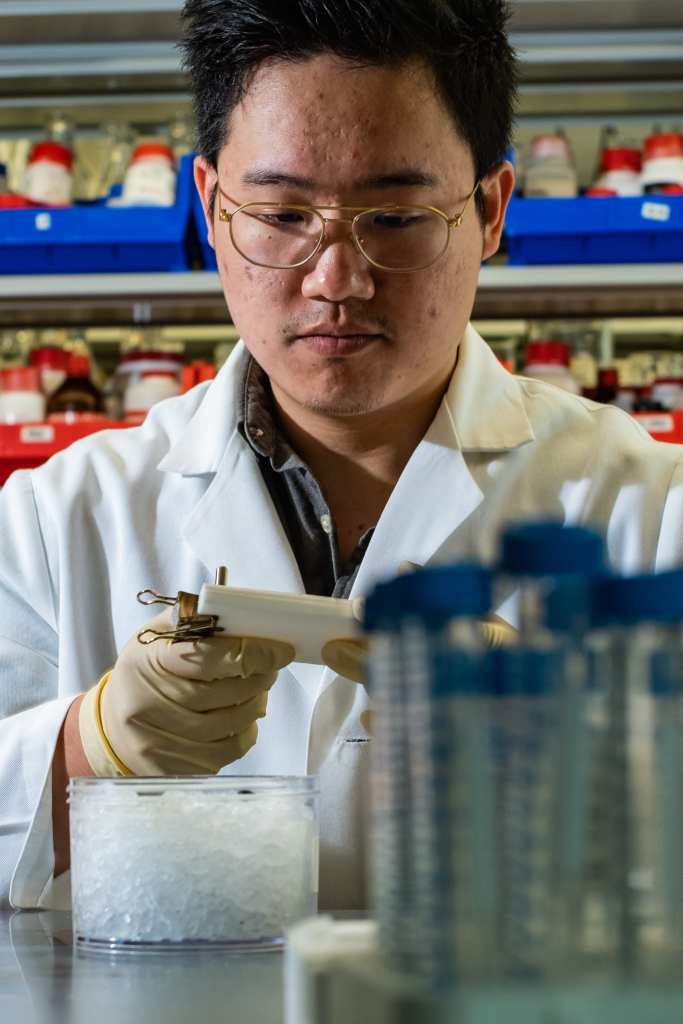
Jason is interested in how individual relationships between cells, proteins, and biophysical factors impact higher-order features of diseased tissues.
In his independent career, Jason is developing a laboratory at the intersection of spatial biology and tissue engineering for disease modeling. His laboratory utilizes bioengineering principles to model and answer systems-level questions about diseased tissues, such as identifying localized trajectories of tissue architecture and quantifying cellular neighborhoods in the lungs and other organ systems.
As an Instructor (previously postdoctoral fellow) in the Longaker Lab, Jason investigated the fundamental biological mechanisms that drive fibrosis vs. regeneration of lungs and other organs using spatial biology, bioinformatics, and machine learning-based image analysis.
As a graduate student in the Mikos Lab, Jason developed click functionalized polymers for modular spatial patterning of biochemical cues for tissue regeneration. He applied these polymers for the fabrication of injectable hydrogels and 3D printable scaffolds.